Small businesses are being locked out of £400bn public procurement market
New “Signed, Sealed, Delivered” report from the FSB highlights that central government spend with SMEs has been “stuck at around 20%” for the past six years.
A new report from The FSB has highlighted the untapped potential of small businesses in public procurement, thanks to a powerful local multiplier effect:
“For every £1 spent with SMEs by public bodies, an extra 63p is generated for the local economy, compared to just 40p for every £1 spent with a larger UK business, and minimal benefit for overseas spend” [page 14].
At Together Gloucestershire, this multiplier effect has been a key motivator for launching our platform, connecting Gloucestershire suppliers and buyers by highlighting the real-time value of spending money with small, local businesses. We welcome this report from the FSB and we have 22 of the county’s biggest buyers ready and waiting for local suppliers like you.
You can take advantage of our work when you join today +
The report also showcases the disparity between local and central government spend with SMEs, as well as the overly complicated tendering process that is restricting SME participation. While local government has steadily increased their spending with small businesses, central government departments are holding the national figures back. The report demonstrates a “two-track system”: some departments (such as DCMS and DfE) already meet or exceed SME spending ambitions, while major spenders like the Ministry of Defence and the Home Office remain far behind, dragging down overall performance. This recognises that it is not an issue of SME capability, but of departmental accountability, paving the way for regulatory or legislative reform for better accountability.
Key stats from the report:
-
62% say finding public contracts is difficult
-
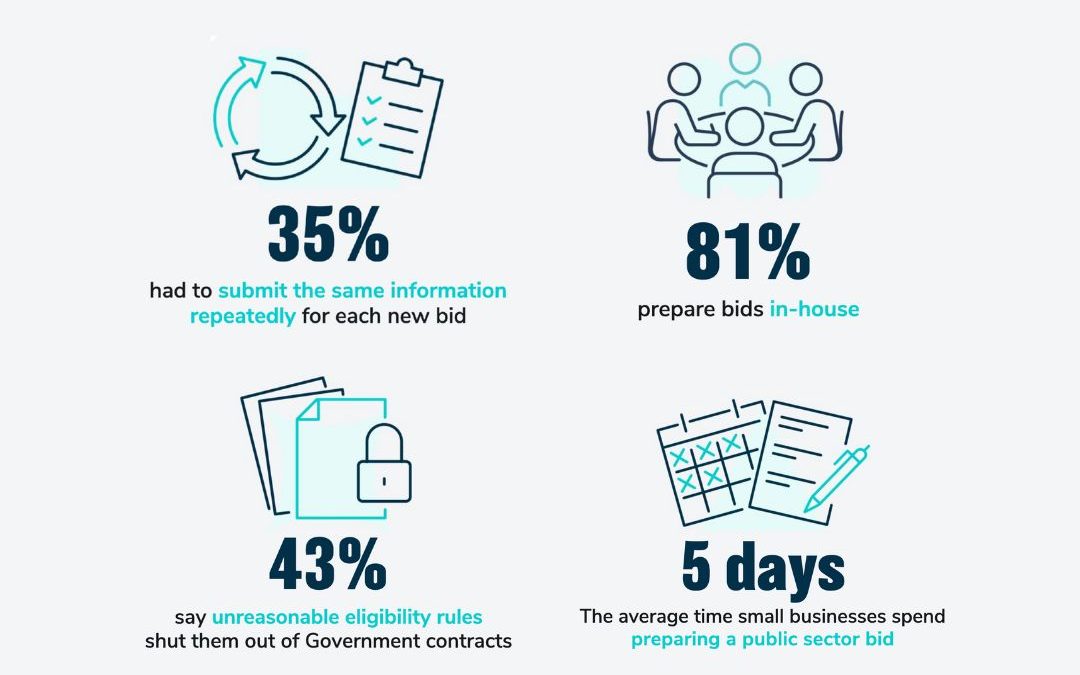
43% say unreasonable eligibility criteria shut them out
-
35% report having to submit the same information repeatedly
-
Only 5% receive adequate feedback after bidding
-
Nearly one in five small businesses say they would not search for public sector work at all, often due to previous negative experiences.

FSB recommends legislative reform and greater accountability:
The report offers detailed analysis of the key issues, including the untapped potential of SMEs, the structural barriers, the bidding process, the quality of feedback available, and the reality of subcontracting. It offers potential solutions, and calls for robust reform and greater accountability to make meaningful change.
The key recommendations include:
-
Mandatory three-year SME spend targets for government departments, with public reporting made available
-
Breaking large contracts into smaller lots by default to encourage SME participation
-
A single UK-wide procurement portal for all public contracts to simplify the process, helping make tenders easier to find and applications consistent
-
Legal caps on turnover requirements for bidders to shift the focus to local over global, small over multinational
-
Automatic full social value scores for small, locally based firms, encouraging local participation
-
A watchdog to intervene where departments miss SME spend targets.
The report also identifies the meaningful value of “meet the buyer” events to demystify local tendering [page 58], something which Together Gloucestershire also values. Keep your eyes peeled for our first meet the buyer event in the coming weeks. Free to members with several member exclusives. Join today +
Other factors identified in the report:
- Small businesses actively avoid public procurement, because the resource investment – typically five days of internal resource – rarely matches the reward, making it a significant risk to the business and impact on potential income generation. It is, therefore, not a lack of ambition that restricts SME participation, but commercial savviness, making it harder to the government to meet their own targets
- Lack of feedback is further reducing tendering engagement, with only 5% of SMEs saying that they receive adequate feedback on their tender responses, if they are unsuccessful. Despite feedback being a requirement under the Procurement Act 2023, caution around legal liability is restricting procurement teams from making relevant recommendations. Statistically, this means that a single bad experience can permanently exclude small businesses from the public sector market, given that they cannot learn, improve, or justify bidding again, something that the report argues is one of the biggest drivers of long-term disengagement.
- Frameworks have “simplified” the procurement landscape, but lock small businesses out for years. They were introduced to enable procurement teams to select a supplier from a pre-approved list, but the process to secure a place on the framework is as complex as the traditional bidding process, and means that new suppliers cannot or won’t be introduced for several years. This limits the opportunity for SMEs to join as they grow, a potentially significant restriction given that frameworks now account for a quarter of government contract values. Ultimately, the report suggests that this approach, which has focussed on efficiency, in fact reduces innovation and resilience by recycling the same large suppliers.
- Most SME public-sector work is indirect, as a subcontractor to larger suppliers rather than as a direct contributor. This accounts for around 60% of government spend. The report outlines how these supply chains are poorly monitored, lack transparency, and are a major source of late payment, despite the governments own target for 30 day payment terms.
- The UK offers bigger tenders than international peers like France and Germany, making it harder for smaller businesses to apply. The report goes on to recommend policy change to address this issue, breaking tenders into smaller lots by default.
- The message isn’t reaching small businesses. Despite the Procurement Act being in force since February 2025, 55% of small businesses are unaware of it.
Well done to Together Gloucestershire Co-Founder Mike Cameron-Davies for his contribution to this report and support of the FSB.
Join today + Read the report +